
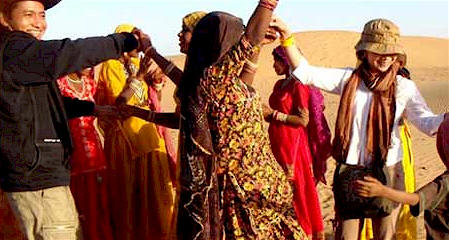
Custom & Tradition In Rajasthan
The origin of the customs and traditions of Rajasthan is easily traceable to
the cantos of the Vedas, wherein specific rites and ceremonies are prescribed in
the minutest detail for the Samskaras in the life of every man and woman. The
Customs and traditions of Rajasthan are the Rajasthani version of these Vedic
rites and rituals. The Rajasthani people have religiously followed the dictum of
the Vedas at every stage from birth till death. They have added some regional
rites and rituals to these Vedic ceremonies. According to the Vedas every man
has to perform certain ceremonies, known as Samskaras, from birth to death.
Sixteen in number, they mainly relate to three major events in one's life i.e.,
birth, marriage and death.
Charms are fastened round the neck and waist and a knife put under her pillow at
night to avert the evil eye. She is not allowed to go for near mahua, khakra or
khejara tree where spirits are believed to reside. It is customary that the
daughter returns to her parents well in time for her first delivery. Festivities
start and women assemble to sing songs specially meant for such an occasion,
some describing the changing behavior and liking of a pregnant woman.
When the birth pangs begin, the woman is given some butter oil to drink to help
facilitate the delivery. A cow dung cake is kept burning constantly, into which
drops of butter-oil and some incense is cast from time to time and offerings are
made to gods to ensure a safe and easy child-birth. Promises are made and vows
taken that if the child is safely born parents will take the infant to the deity
in due course and offer obeisance in person by shaving off the hair on head the
baby. If the birth pains are excessive or unbearable, sorcerer's help is
resorted to. Many women, to checkmate such an eventuality, start to wear charms
prescribed by wizards as soon as they realize that the pregnancy has occurred.
When the child is born, the naval cord is cut with a scythe and the child rubbed
with wheat flour and given a bath. The cord and the placenta are buried
carefully by the new father's sister to prevent their coming in the possession
of any animal, evil spirit or magician. The birth of the child is announced by
midwife, the nayan-wife of the family barber or by a senior relatives and close
friends and ties strings of mango leaves at their doors and with the help of cow
dung or red earth draws a swastika, a symbolic representation of Sun, as a sign
of good wishes and good news on the occasion
The woman is given a partial bath after the delivery. A regular bath is given on
the sixth or seventh day when she is dressed ceremoniously and is brought out
from the delivery room by the younger brother of the husband to worship the Sun.
the baby, anointed with oil and lamp-black put on the eye-line and a red or blue
string tied round its waist, is brought out along with her. Both are then taken
in a procession to the village well for worship called jalwa.
Although the birth of a son is the most welcome event, a daughter in the family
is also considered essential. Parents who are not blessed with a daughter to
offer in marriage feel themselves unfortunate, as kanyadan- bestowing of
daughter is one of the samskaras- religious obligations prescribed by the
tradition without which one's life is not considered complete. Children are
named usually after gods and goddesses. The tribal folks name their children
after the genius presiding over the days on which they are born.
Welcome Rajasthan Travel & Tourism Services
(Authorized by Tourism Dept. Govt. of Rajasthan)
C/O Umaid Mahal
,C-20 / B-2 Bihari Marg, Jai Singh Highway,
Opp. Lane of K.P. Automotives, Bani Park, Jaipur - 302016, Rajasthan (India)
Telephone : + 91-141-2205528 / 4914416 (09:00 A.M. To 06:00 P.M.)
+91-9829614748 (06:00 A.M. To 06:00 P.M.)
Fax : +91-141-2204470
For Car Rental Email: welcomerajasthan@yahoo.com
For Tour Package Email: info@welcomerajasthan.com
Emergency Contact Number : +91-9829614748




Other Information
City Distances Passport and Visa Information What to Pack Useful Phrases
Car Rental Services
Rajasthan Tour Packages
Tours from New Delhi
Rajasthan Historic tourMewari Tour with Agra
Classic Golden Triangle
Rajasthan Wildlife Safari
Rajasthan Real Adventure
Rajasthan Tour with Agra
Jaipur city tour w/ Pushkar
Rajasthan Desert tour
Classic Desert tour
Jaipur city tour
All tours starting from New Delhi
All tours starting from Jaisalmer